For an awfully long time England as a nation suffered a footballing identity crisis.
Ironically, the starting point for this enduring self-doubt was their historic zenith, winning the World Cup on home soil in 1966. Beating West Germany at Wembley their star player was Bobby Charlton who six months later was crowned Ballon d’Or champion.

The Three Lions resided on top of the world and furthermore were in possession of the best individual.
So when the national team subsequently failed to qualify for the tournament in 1974 and 1978 naturally deep concerns arose about what had happened to an institution that had recently boasted such global presence and prowess.
These insecurities only worsened when England later encountered a series of quarter-final and semi-final exits at major tournaments.
What exacerbated this anguish was a reluctance to join a tactical revolution that saw possession-based fare become the norm. As England’s international rivals increasingly leaned into technically gifted players, they themselves doubled-down on perceived cultural strengths, that of fighting spirit and commitment.
Across an array of different managers, eras and tournament disappointments the same debate raged. Should England embrace craft over graft; tiki-taka over passion?
For several generations this was their identity crisis.
Compromise and goals
Enter Gareth Southgate, who purposely sought a middle-ground and by doing so ushered in a successful period for the Three Lions, twice reaching a Euro final.
It was a transformation in fortunes powered by the prolific goal-scoring of Harry Kane, a forward who first established himself as an elite finisher at Tottenham before becoming a reliable and relentless attacking totem for his country.
In England’s last six major tournaments, Kane has scored 21 goals, a lofty total that includes a priceless semi-final winner at Euro 2020 and the decisive goal at the Estadio Azteca this summer that secured England passage to the last eight.
Of course, his international prolificacy extends beyond major finals too. Remarkably, since the tail-end of 2022 Harry Kane has converted 38.4% of England’s goals.
Unquestionably therefore, he has proven pivotal in his nation’s resurgence on the international landscape and, in doing so, he has elevated his own standing, beyond the considerable feats of being viewed as a Premier League legend and a lethal Bundesliga hit-man.
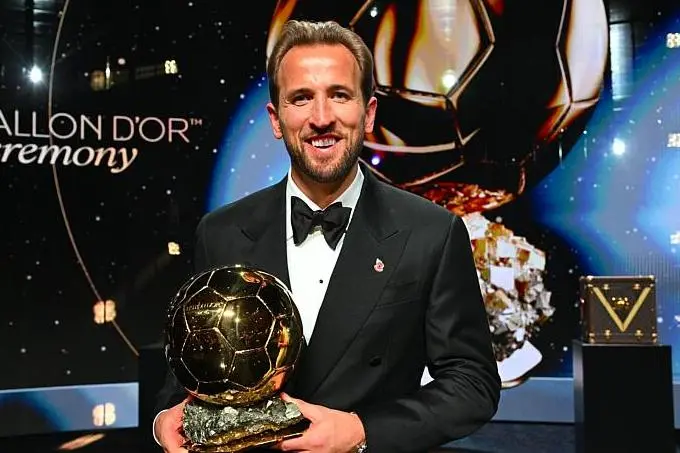
On Monday evening, he ascended to the London Palladium stage, to be crowned the 2026 Men’s Ballon d’Or champion.
But before we ask what this momentous achievement means, for Kane, England and a nation’s sporting psyche, another fascinating detail needs to be explored.
It is that Harry Kane’s fluctuating circumstances directly mirrors that of his country, even if one tale of hardship to triumph spans entire generations, while the other merely dates back to Brisbane Road, Leyton Orient’s ground, in 2011.
A shared journey
Kane wasn’t always the lethal harvester of goals we are so acquainted with today.
During his early days at Spurs he was loaned out on four separate occasions, the first two – at Orient and Millwall - in order to develop his forward-play and gain valuable experience. The latter two, frankly, materialised because Tottenham had no pressing need for him.
A stint at Norwich ended prematurely when he failed to make an impact at Carrow Road. It was a similar story at Leicester who were pushing for promotion at the time.
Either ensconced on the left-wing or sitting frustrated on the bench, Kane left the East Midlands having scored just two goals in 13 appearances.
Twenty years old at the time, and with a regular starting spot at Tottenham seemingly a million miles away, the youngster must have wondered in this period what had become of the projected success that accompanied his bountiful number of goals scored at youth level.
His career was supposed to take a linear upward trajectory but instead it had already plateaued, regressed even.
Amidst this harsh reality check, the demand became clear: to adapt, work harder. To reinvent.
It was these difficult experiences that Kane alluded to on Monday evening when he spoke in his acceptance speech of a journey not straightforward and in many ways these tough times are comparable to England’s unexpected fall from grace in the Seventies.
But while Kane absorbed the life lessons and adjusted to a new reality, regrettably England way back when, did not.
A star is born
The player’s admirable resilience, and dedication to self-improvement soon bore fruit and once in situ at Tottenham there was no looking back.
Across nine seasons in North London he converted 20+ league goals on six occasions, won the Premier League Golden Boot three times, and was even awarded the Playmaker of the Season merit in 2021 after conjuring up 14 assists.
That stand-out season led to the player finishing 23rd in the Ballon d’Or rankings.
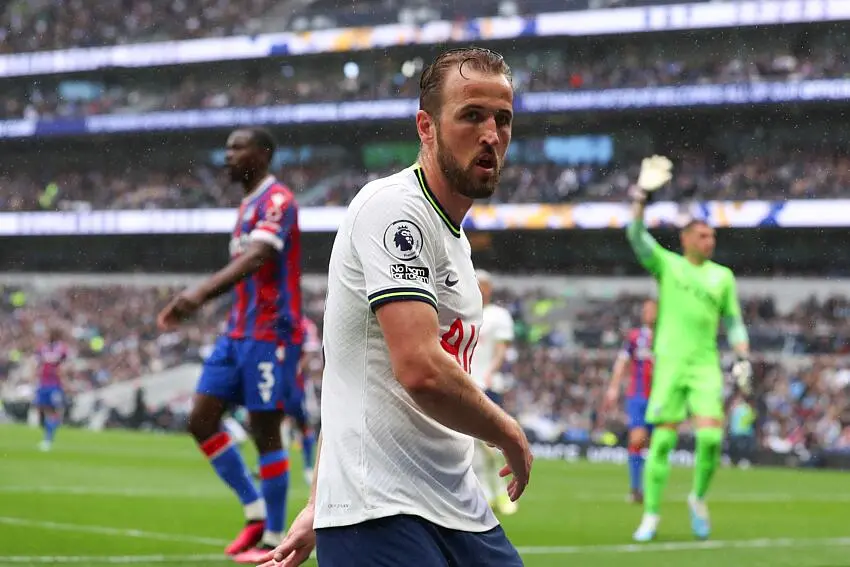
Yet while his near-decade in the Premier League led to personal veneration it did not directly translate to team success, as Spurs perennially challenged near the top of the domestic table – and reached the Champions League final in 2019 – only to consistently fall a little short.
In this respect, Kane’s journey at this juncture mirrors that of England’s ‘Golden Generation’ of the late-2000s, made up of a team resplendent with superstars who always excelled without reward.
Pertinently, around the time Kane left for Bayern Munich the persisting joke was that he was extraordinarily talented, but forever destined to never win a trophy.
That exact same charge was often levelled – justifiably as it turned out - at England post-Millenium.
A new perception
So what of now, with England producing their first Ballon d’Or winner since Michael Owen, a quarter of a century ago?
Directly related to the nation’s identity crisis is an untold number of debates held down the decades, both in print and in pubs nationwide, about whether England actually have world class talent. Or if we simply place them on too high a pedestal.
On Monday evening, an immaculately dressed 33-year-old proudly took to the stage and ended that discussion.
Moreso, with twinkling creatives such as Phil Foden, Bukayo Saka, and Cole Palmer at the fore, England no longer looks across the channel, to France and Spain, and covets their flair. The identity crisis has finally passed.
Not to a whole extent but to a great extent, Harry Kane did that.
England may still be seeking a major tournament success to add to their 1966 triumph but they are secure with where they reside, near the world’s summit. And in their unassuming, hard-working, anti-superstar striker they once again possess its best player.
